
Greenwood Projected Versus Actual Release
The SCDC current-inmate profile calls its estimate “Projected Release Date.” SCDC defines it as the date when the department expects an inmate to satisfy all incarcerated terms, assuming work, education, and good-time credits continue at the current rate. The date may move. A disciplinary rule violation and loss of credit can push it later.
An actual release date records an event that has already happened. SCDC's separate Released Inmate Search is the correct state source for that event. Greenwood County jail records serve that role for a person leaving the county detention system. The distinction is basic but crucial: projection looks forward, while a release record looks back.
Scheduled versus actual: Never state that a person was released merely because a projected date passed. Check the releasing agency's event record and any new custody or supervision status.
A pretrial detainee has not yet received a final sentence calculation. Bond, dismissal, plea, sentencing, a hold, or a transfer may determine when that person leaves Greenwood County Detention Center. The court docket can explain legal authority, but the jail record confirms physical departure.
Find Greenwood Projected Release Dates
Choose the source by custody type. A person at Leath Correctional Institution or another SCDC prison belongs in the SCDC public offender search. A person serving a local sentence at Greenwood County Detention Center must be checked through the jail records unit and the sentencing court. The state search excludes people sentenced only to a county detention facility.
- Confirm the facility. Use Greenwood JailTracker for current county custody and SCDC for state custody.
- For an SCDC prisoner, search by name or SCDC identifier and open the correct profile.
- Read Projected Release Date separately from Projected Parole Eligibility, sentence length, and current location.
- For a local sentence, ask the Detention Center for the recorded sentence computation and compare the court order.
- After departure, verify the actual date in the SCDC released list or Greenwood release sheet.
The successful SCDC current-search capture shows where an active state record presents projection and sentence information.
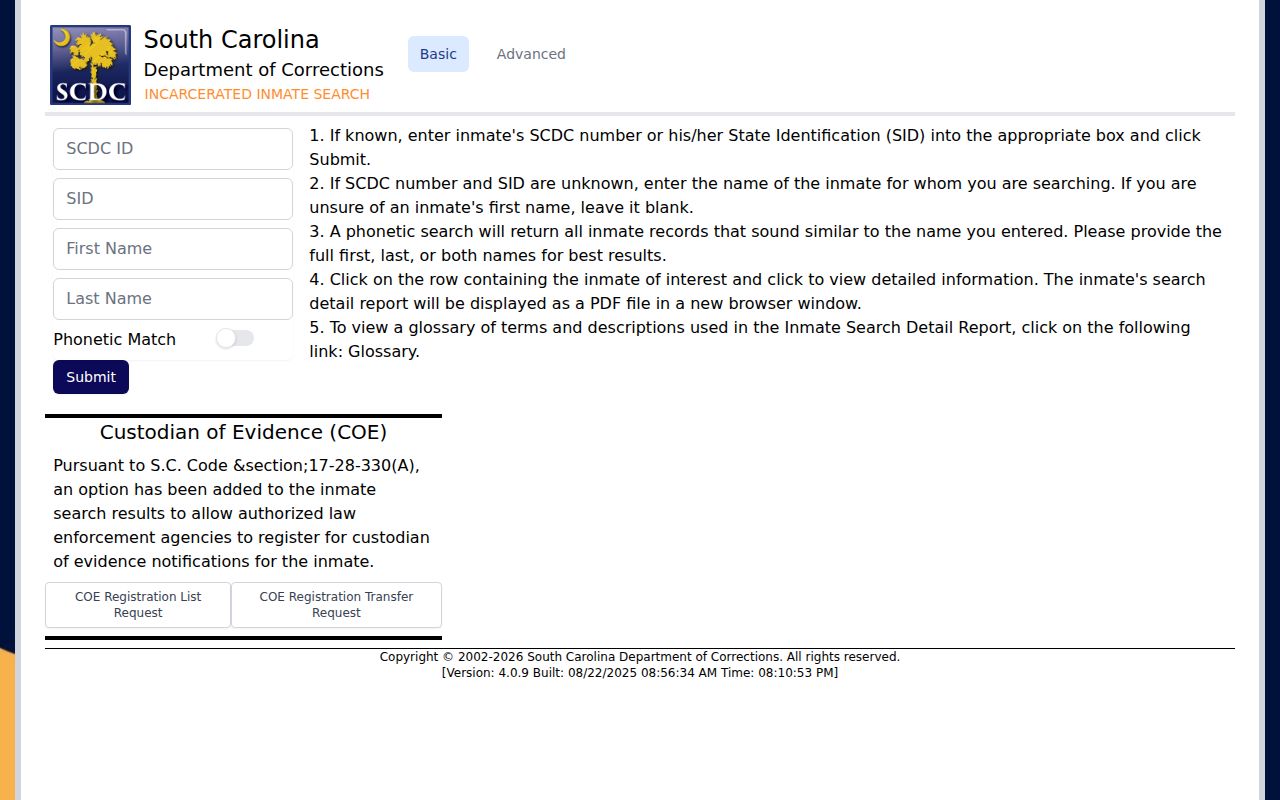
That profile is an active-custody source. It drops outside the tool's stated scope after release, so the separate released-inmate system must then be used.
Greenwood Release Calculator Limits
SCDC also offers a Release Date Calculation tool. It gives general guidance based on the supplied sentence facts and an earliest-possible credit scenario. It is not an official inmate record. Lost or unearned credits can delay the result, and the calculator does not account for every other conviction.
The tool should not be used for a person who has already been sentenced, because SCDC maintains that person's actual department computation. It is also not designed for Youthful Offender Act cases. Questions about a sentenced state inmate's calculation go to SCDC Inmate Records at 803-896-8531.
The successful SCDC calculator capture includes its input, disclaimer, and example output.
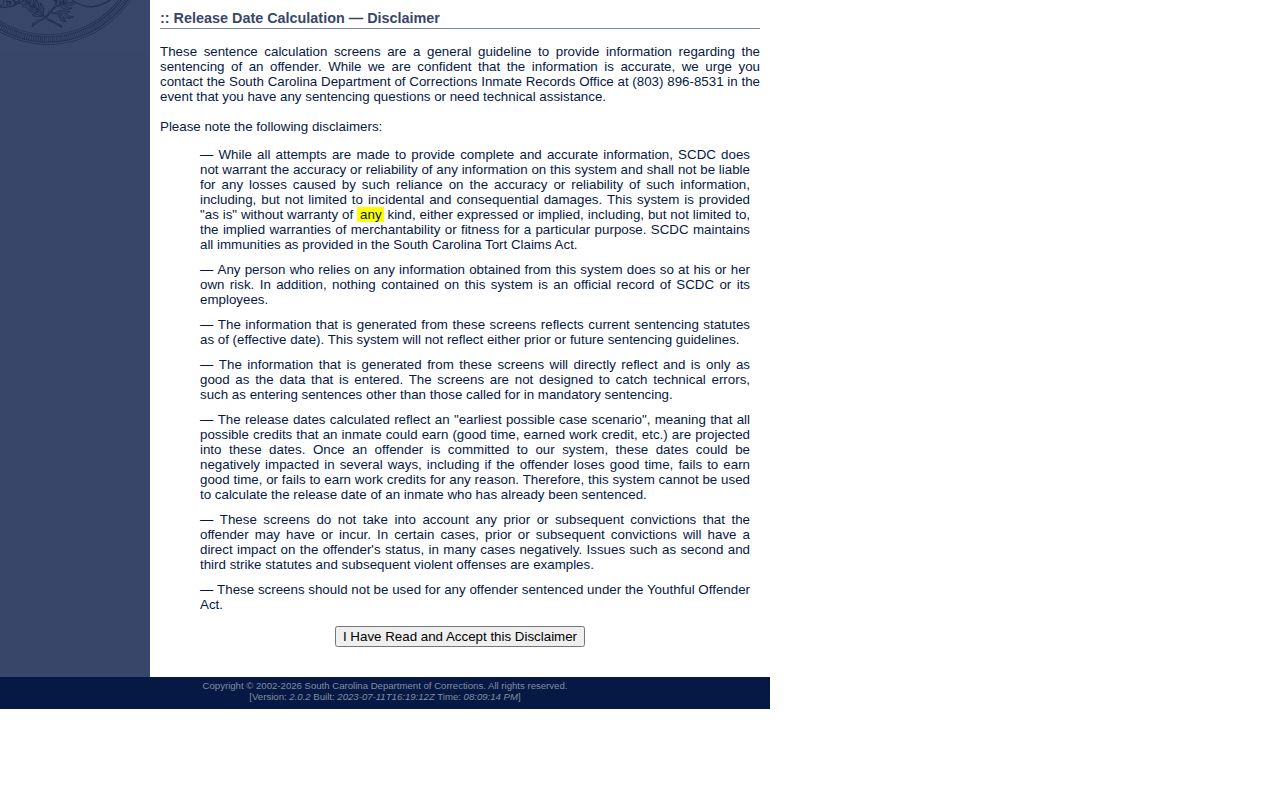
The disclaimer is part of the result. Treat the calculator as an estimate, then use the official profile or records office for a named sentenced person.
South Carolina Release Credit Rules
South Carolina Code Title 24, Chapter 13 contains several credit rules. Section 24-13-210 gives an eligible SCDC inmate who was not convicted of a no-parole offense twenty days of good-conduct credit for each month served when institutional rules are faithfully observed. A person serving a no-parole offense may receive three days per month, subject to exclusions and the statutory floor.
For a sentence to a local detention facility or county public works, subsection 24-13-210(C) provides one day of credit for every two days served when the person complies with the rules. This applies to a local sentence, not to every pretrial stay. The responsible official may forfeit some or all good-conduct credit for misconduct. Consecutive sentences are computed using the aggregate sentence, and state law uses a 365-day year.
Work and education credits use different rules under §24-13-230. For an eligible SCDC inmate who is not serving a no-parole offense, the director may allow up to one day for each two days in qualifying work or education, with combined credit capped at 180 days per year. For a no-parole offender, the potential rate is six days per month and the cap is 72 days per year, still subject to statutory exclusions and the incarceration floor.
- Good-conduct credit
- A sentence deduction tied to compliance with institutional rules.
- Earned credit
- A possible deduction tied to approved work or education.
- Mandatory minimum
- The least custody time the controlling law requires.
- Projected parole eligibility
- A date for possible Board consideration, not a promised release.
Greenwood's 85 Percent Rule
South Carolina does not impose one flat percentage on every inmate. Section 24-13-100 defines a “no parole offense” by felony classification and maximum penalty. Section 24-13-150 then sets the truth-in-sentencing floor for that statutory class. Except for death or life sentences, a person convicted of a no-parole offense and sentenced to SCDC may not receive the listed forms of early release until serving at least 85 percent of the actual term imposed.
The percentage applies to the unsuspended term without using work, education, or good-conduct credits to cross below the floor. Offense class, maximum penalty, sentencing date, mandatory minimum, suspended portion, and judgment still matter. The safe statement is that the 85 percent floor applies to South Carolina's statutory no-parole category, not that every Greenwood inmate serves the same share.
Credits may change a projected date within the law. They cannot erase a mandatory floor. Obtain the judgment and SCDC computation before attempting to calculate a named person's date.
What Changes Greenwood Release Dates
A projected release date rests on facts that can change or that the public calculator may not know. SCDC updates its own computation as sentence, credit, and custody information changes. County sentence calculations also depend on the actual court order and local custody record.
| Factor | Possible effect | Where to verify |
|---|---|---|
| Good-time loss | May move the projected date later after discipline | SCDC or local sentence record |
| Work or education credit | May reduce time when earned and legally allowed | SCDC computation |
| Detainer or hold | May move the person to another custodian at release | Agency and release record |
| Corrected court order | May change the controlling sentence facts | Court docket and inmate records |
| Consecutive sentence | Uses aggregate time for good-conduct calculation | Judgment and SCDC record |
| Parole decision | May allow supervised release, but eligibility alone does not | Board result and SCDPPPS |
A detainer is a request from another authority to hold or receive the person. Leaving SCDC for another agency is an exit from SCDC custody, but it is not freedom in the community. Read the release type and destination together.
Greenwood Parole Date Computation
Parole eligibility is separate from the projected end of incarceration. S.C. Code §24-21-610 provides a framework for parole-eligible cases. It uses at least one-third of the term or a longer mandatory minimum for a qualifying violent crime, and at least one-fourth for another parole-eligible crime. Life and very long terms have additional rules.
Those fractions are not universal. Murder, armed robbery, certain drug trafficking offenses, modern no-parole offenses, offense dates, and mandatory minimums can change or remove eligibility. Good behavior is not deducted when calculating parole eligibility under that section, while earned-work credit may apply subject to exceptions.
Reaching the eligibility date only permits Board consideration. It does not compel a grant or physical release. A conditional grant may depend on prerequisites. Compare the hearing result, the SCDC actual release event, and SCDPPPS supervision before describing a person as released on parole.
Confirm Greenwood Actual Release Dates
After the projection passes, search the SCDC Released Inmate Search for a state prisoner. It requires a beginning and ending release date plus county, with Greenwood available in the county menu. Results display release date and release type. Read both. “COMMUNITY SUPV” or “PROBATION” indicates that prison custody ended but a community status remains.
For a person held only at Greenwood County Detention Center, request the booking and release record from the county. It can distinguish bond, time served, sentence completion, court order, or transfer. A vanished current-roster entry does not show which event occurred. The court record can support the legal basis but may precede physical release processing.
VINELink Release Check can provide an alert about a pending custody change. The alert is not a certified event record, so follow it with SCDC, SCDPPPS, or the Greenwood jail. The best chain is projection while incarcerated, the releasing agency's actual event record, and a supervision check when the release type calls for one.
Sentence records should be read as a set. Admission date, sentence length, suspended time, offense classification, projected release, and parole eligibility can each describe a different part of the term. A projected date on an active SCDC profile does not include the suspended probation portion in its sentence-length field. That is another reason the prison date may not equal the final end of all legal supervision.
For a locally sentenced person, ask for the recorded computation instead of applying the state-prison rate by hand. Section 24-13-230(E) allows credit tied to a mandatory productive-duty assignment, while §24-13-235 permits a county to authorize a voluntary public-works program. The research did not establish that Greenwood operates such a program or which local rate it has selected. A county policy or records response is needed before adding either credit to an individual estimate.
Release on the projected date may still lead to parole, probation, community supervision, or another custodian. Check SCDPPPS when the release type indicates supervision. If a detainer is present, ask which agency received custody. This keeps the answer focused on the exact event rather than assuming that departure from one institution ended every restraint.
When the public profile and a court paper appear to differ, contact SCDC Inmate Records rather than selecting the earlier date. The department computation can reflect sentence aggregation, credit history, and statutory limits that a single docket entry does not show. Keep the SCDC ID ready, and ask which incarcerated term controls the current projection. After release, the released-inmate row becomes the event source, while the old projection remains only a prior estimate.
Note: A future date is an estimate; only the originating custody source can confirm the completed release or transfer event.